


Kho ate plenty of turnips at dinner. They dined on the porch under the yellow bug-light while the sky dripped, eating bowls of turnips and butter, and carrots, which Kho slid into her mouth and ground among her many sharp teeth. There was chicken curry, which Kho sniffed delicately and tasted, but did not like. Dad played the guitarina, and Kho, attentive, sat in her odd squat, lightly clacking her broad dark nails on the floorboards.
The collective was still harvesting, so there was no school. Sri and Senarath were to ride the truck down the fields, scavenging in the soft clods for anything grown-up gleaners had missed. Mum tried to keep Kho with her and the other mothers at the granary (“What can she do to help, blind?”), but the girl wouldn’t stay, running after Sri and the other kids from lower-school.
Their friends stared, fascinated, as they waited for the truck, gingerly touching her face and withdrawing, shivering.
Her face was what bothered people most. Her whole head was blunt, pushed forward something like a dog’s, pale and rumpled, the flesh delicately spongy, almost like mushrooms. There was not even a sign of where eyes should be, and after looking at her long enough and sketching her in her classwork book, Sri decided the whole top and front of her skull was a single smooth, pale, leathery, leaf-shaped organ, lightly spotted cream-and-beige. It was from this surface that the tingly, almost inaudible skreek and hum emitted from.
There were not any ears any more than eyes, no nose that Sri could see, and the mouth, when closed, wasn’t obvious, but when open, it was broad enough to eat whole carrots comfortably. Which she did; fresh-pulled, clean-washed, or boiled, it did not matter.
Neck, shoulders, and torso blurred together. The arms and legs were long. When still, she was still indeed, but when she moved, it was with a sort of a lope.
“If she stood straight, she’d be almost as tall as Mum,” Senarath commented.
But Kho didn’t. She folded herself like a camel cricket and, when at rest, squatted, faintly humming to herself.
“What does she eat?” “How does she sleep?” “Does she poop?” The kids pestered them with questions.
“She sleeps with me,” Sriyani said. “I gave her an old nightgown, and she slept in my bed next to me.”
“Can she help us?”
“Even Senerath can help,” she said.
“Hey!” he yelped.
The clouds parted, shredded, dispersed. Kho, pleased at the warmth, turned her blank face to the sky. The kids danced in puddles spangling gold sunlight, and Kho held their hands and joined them, croaking along with their songs.
Then the truck came, and they climbed on.
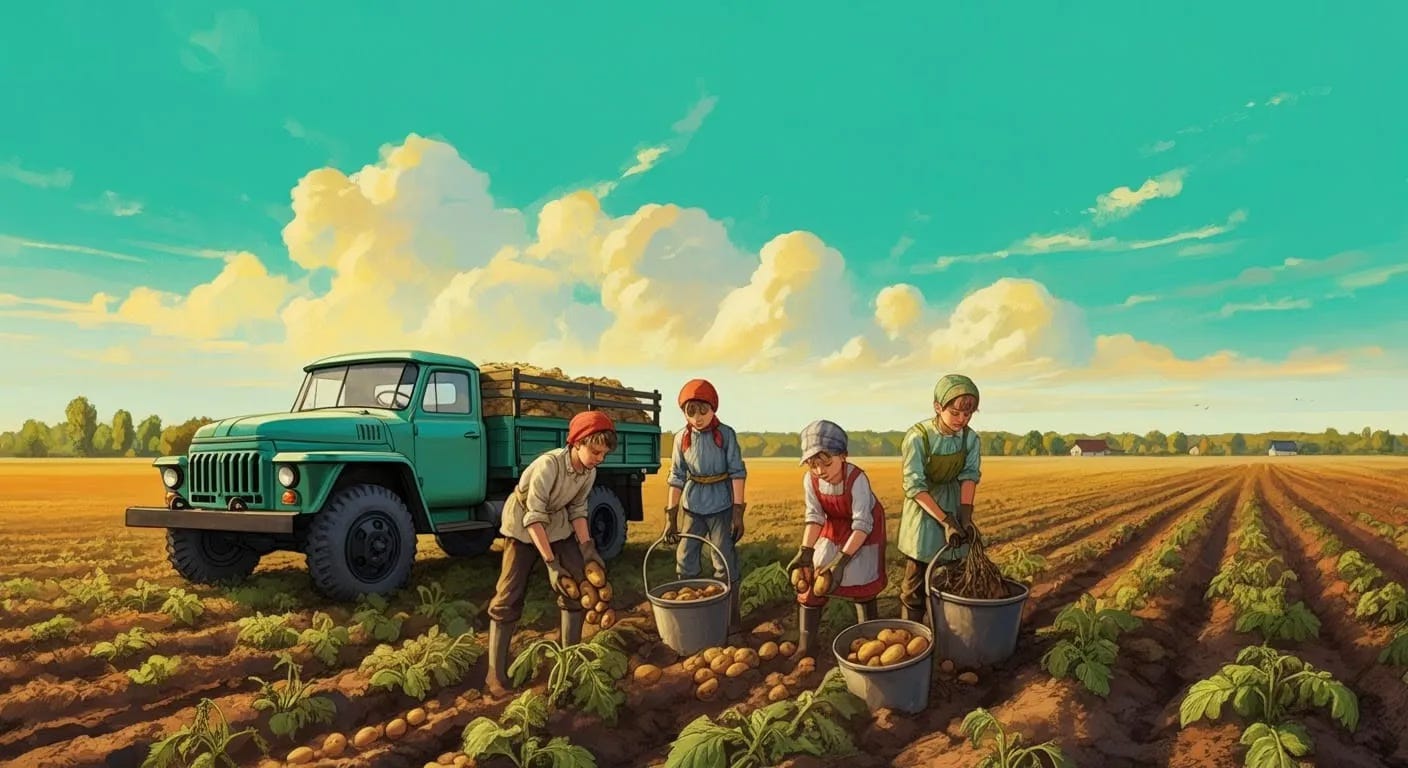
The kids dug after left-behind potatoes. Kho joined with great efficiency once she knew what they looked for, leaning over the furrows and considering. Every time she went scrabbling in the soil with her wide hands, she brought one up.
“It’s like she can see ’em down there!” Senarath said, and Sriyani agreed.
Work was hard at harvest, and they had days to go. Kho dug, carried, and lifted, and the kids grew accustomed to her, though her odd face, popping up over a lunch table at the community hall, still gave the mothers a start.
She learned to say potatoes, carrots, and beans and liked to eat all of them. She said Sssree, and Ssnarat, and Dah, and Muh. Nurse Vanderbilt visited daily: Kho called her Kktt Vntbilt. When the nomarch visited, she called him Kktt Ssmit. Sri tried to write down everything she heard her say, which wasn’t easy because Kho could make sounds no one else could. Sri could not decide if Kho made them with her mouth, the organ on her face, or both.
Nomarch Schmidt was puzzled. “She’s not talking, exactly, Sriyani?”
“No, sir. I teach her words, and she learns them, or she picks them up. However, she doesn’t talk exactly. Not sentences. I think,” Sri added, “she does a little, to herself, but not in Iphigenian.”
“No one speaks anything but Iphigenian except very old people.” The nomarch rubbed his chin. “Bring her to the community hall tomorrow, Mist’ Pauloviĉ will be there. He can speak an old language. Try her out on him. See what he thinks.”
The three children walked down the lane to the community hall after breakfast: Kho, with her waddling gait and muddy feet, and Sri and her brother, tromping along in their boots. The sky was now brilliantly clear, and the birds strolled the mud, searching for bugs, worms, and seeds. The drab town looked friendly and warm, though the cold autumn could only be two weeks away.
Mist’ Pauloviĉ, very old, sat on the porch with a lap blanket. “Hello, Mist’ Pauloviĉ!” Sri said.
Mist’ Pauloviĉ, wrinkly and spotted brown on white, had hardly any hair. His sightless eyes were milky. “Is that Sri I hear? And Senarath, always tagging. And I hear someone else with you.” He reached, and Kho put her hand in his, looking, in her blind way, closely at him.
“What a unique handshake,” the old man said. “This must be your friend. I’ve heard of her.”
“My new sister. This is Kho. Kho, this is Mist’ Pauloviĉ.”
“Kktt Povits.”
“Kho, may I touch your face?” He raised his hand gently.
“I don’t know if she can understand,” Sri began, but Kho did, or guessed, collecting his frail fingers in her wedge-shaped grip and bringing them to her. Mist’ Pauloviĉ searched her features and head with great attention, his lips working and pursing, then bent his face for her inspection.
“The nomarch said to see if she spoke your language.”
“Did he?” He sounded amused. “I doubt she can, but I’ll try.” He spoke a little to her, but she didn’t answer.
“I can feel her looking at me,” he said.
“What do you mean?” Senarath asked.
“Does she make that noise all the time?”
“Yes,” Sri said.
“She’s seeing me.”
Sri felt warm inside. “Do you think that too?”
“She makes sounds we can hardly hear. They say she’s blind, but I think she can see better than any of us.”
“She can see potatoes in the ground,” Senarath said.
“I’m sure she can. I’ll bet she can see your heart right in you. I can feel her looking at my face. No human can do these things, Sri.”
“But what can she be?” she asked timidly. “Could—could she be something that the Biosphere Corps made?”
“I don’t think so. The Biosphere Corps made everything that’s alive except humans and the native things—but I’ve never heard of them making anything so different.” He stroked Kho’s hand, and she chittered. “She came across the flood, I hear. So she came from the Badlands, or the Upper Plateau itself.” He shrugged. “Iphigenia’s huge, and we’ve seen almost none of it. We may never know where she came from. What she is. She doesn’t feel or smell Terran, but she doesn’t feel like anything I’ve touched that’s Iphigenian, either. She’s…sui generis.”
“What’s that mean?”
“Unique. All to herself, maybe.”
“Special,” Senarath said.
“Don’t tell anyone what you think, please,” Sri said. “They say she’s deformed, and they pity her. I don’t know what they’d think if…”
“They may guess. The nurse is no fool, and Schmidt’s a clever man, that’s why the polis collective’s elected him three times. But I won’t say anything.”
Sri kept writing down words and teaching them, and learning one or two, and the end-of-summer skies dried, and the high floodwaters retreated until the wide saddle to the Badlands lay exposed again under the sun.
Two days later, a group of men crossed it, entering Gythion.