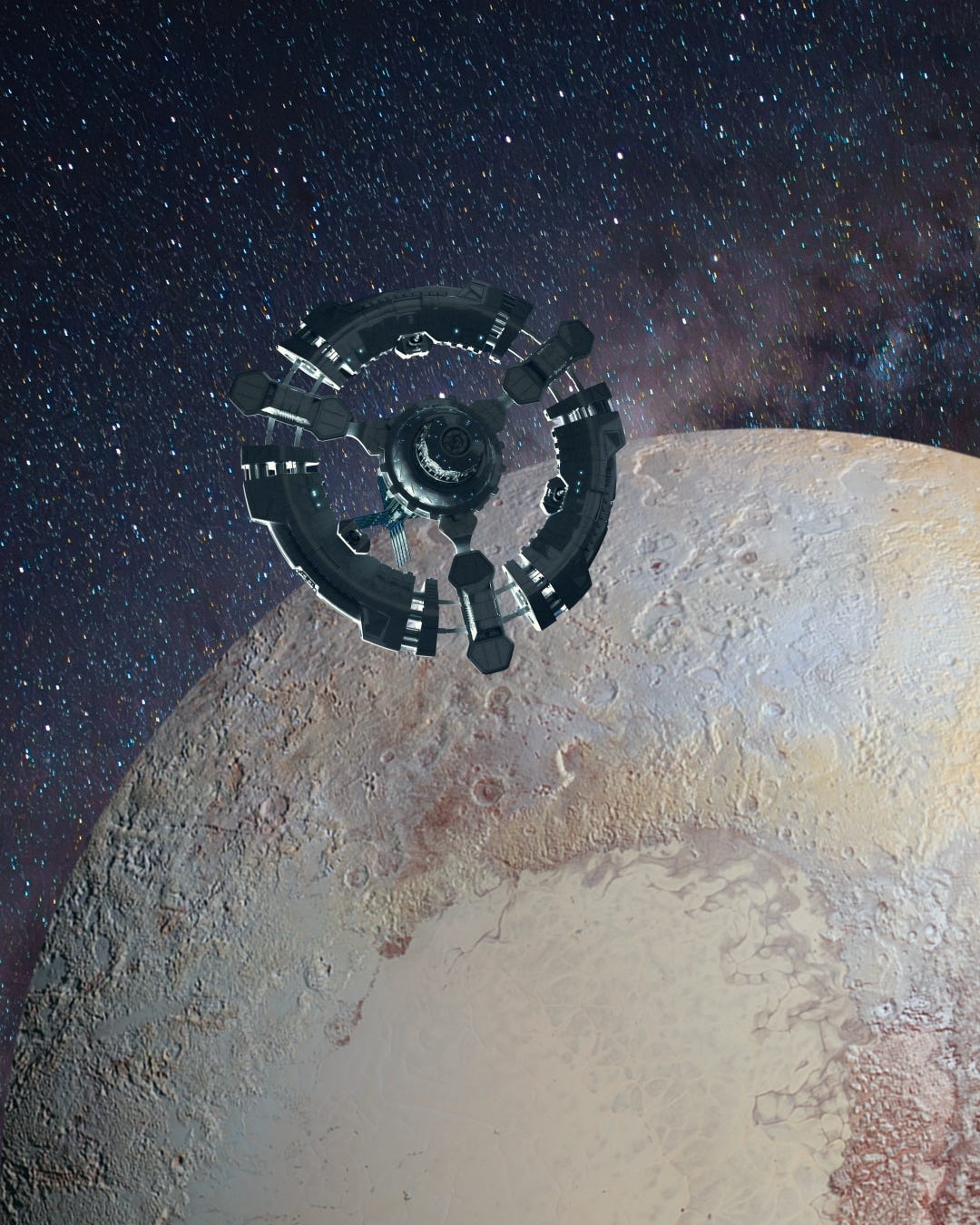
Sylvandro was up early the last dayshift he was on Odysseus Station. Both Station and Sylvandro were in a quiet mood, and he walked the service deck, thumbs in his sash. The view-windows looked down on the cold, bleak planet below, a cratered white-and-gray-and-black surface two thousand kilometers away, one pole delicately frosted.
The Station rushed over the night side terminator, over vast Desthyn Crater, and the twinkling lights of the mining settlement inside. On… on… on… into the full nightside, the stars a sheet of spangles.
There was a wooden rattle-clatter behind him.
“Come over and eat!” someone called.
Sylvandro pivoted on his bootheel. There was a row of thermos behind, little eateries mostly dark at early-shiftover, but the one at the corner was opening. A thin woman gave a wave of her hand as a teenage boy pushed the shutters to and latched them open, tock-clock.
“You’re opening because of me?” Sylvandro asked.
“You want to eat, MI?” she said. “I see you walk by every day. Up early? Or up late?”
He smelled the food already starting, a gray, sweaty man busy behind the counter.
“Both,” he said. “But I have to eat.”
“Zerchi, breakfast up,” she said, without turning around.
“Aye that,” Zerchi said, shoulders tight and hunched.
The woman’s face was lean, her eyes dark, sad, and far away. “You didn’t sleep, did you?”
“Is it obvious?”
She smiled. “A quality man like yourself should have shaved. And you look, sir, as though you’d not slept.”
“Quality!” He laughed. “Are you an expert in quality men?”
“Once.”
He nodded, understanding. “You’ve done well?”
“I have done,” she said, cautious. “I open early every morning. Not just for lost aristoi.”
“Now you think I am aristoi.”
“What else? Officer? Man of quality? Knows he needs a shave but too busy to have one? Important, and busy. Medals. Boots shined, dignity. Knows what I am. What I was.”
“I’m out here at Odysseus. I could be anyone.”
“Odysseus is important. Fleet headquarters? I see many aristoi. You are one.”
“Guilty,” he smiled. “But I am leaving soon. Now where’s breakfast?”
“Patience. It comes. You owe me eight obols.”
He counted out the dull coins onto the wooden counter and looked her heel to head. Workworn hands, plain but good clothing. Black hair tied up with mechanical precision, shot with a few gray hairs. Mid-fifties: over ten years older than he. A bit of glass jewelry, gracefully positioned. Iron manumission anklet. The passive, dove-like eye of a tank-girl, fading into the slow cynicism that came with their middle-age.
“Who’s your patron?” he asked.
“Now you play inspector,” she said.
“I thought that was what we were doing here. Isn’t it a game?”
Her mouth quirked. “If it please you.—The old column-commander was my patron. He went home. He left me here, and he died last year. I was too much trouble to take home. Now I send my money to no one, but I have no protection either. If the Station can fill the space better here, I will be thrown out on the decks, and die a beggar, sir.”
“I hope you aren’t looking for a new patron.”
She shrugged, a lingering elegance in her motions. “I have to protect myself.” She nodded at the boy and Zerchi. “I have to protect my staff.”
The boy ran out a stool for Sylvandro. It was old and creaked.
“I leave Odysseus today, Miss…?”
“Pulida. Pulida Solorioino.” An expression of despair fleeted across her face, was smoothed away.
“Ahhh. Column-Commander Solorio. I’ve heard of him. Drowned, I hear.”
She bowed her head slightly. “So I hear. His solicitor sent me my final release, some months after.”
“A good man.”
“So I hear.”
He cocked his head, but did not question her. Zerchi walked to the counter with a hot bowl with a lid. Sylvandro set the lid aside, discovering a diabolical breakfast: six rounds of fresh flatbread dripping with oil, garlic, and basil; the deadliest of blood puddings; and a glut of jam darker than molasses over them all. He probed that last. Currant.
Shrugging, he pulled his knife and cut the pudding. The thermo-owner stood at the end of her counter, watching him eat. He noticed her blue glass bracelet.
“Where are you going after you leave?” she asked.
“Out,” he said shortly. “Deep space. An… experimental ship. Nine-month cruise high above the ecliptic… long orbit.”
“Is that dangerous?”
“Why do you ask?”
“You look like a man who laughs at danger.”
Sylvandro smiled ruefully. “I look like a man with a young wife and no children yet,” he answered. “But duty calls.”
“Duty,” she echoed. The boy had a broom out and swept the decking in front of the thermo. Crumbs, dead flies, toothpicks. “I know about that. You see him?”
“Yes.”
“If I fail here, he’ll have to enlist, and he will have duty also. There’s hardly any civilian jobs here for men except for retired clients of officers.”
Sylvandro looked at the boy. “He’s your son.”
“Behnooŝ,” she said. “Eighteen, sir.”
Behnooŝ paused in his labors to grin and bow,
“The column-commander’s son?”
“Yes.”
“On you.”
“Yes.”
“Did he recognize him?”
“He did not. Why else would we be here? Column-Commander gave me a son and freedom and an investment and nothing else, not even sky or clouds or open water… Then he died.—You must think me bitter.”
He carefully folded jam inside of oily bread, and contemplated the dark, bloody drips as they fell on the pudding and into the gold and green pool at the bowl’s base, rolling across the skirts of some nymph. “No,” he said. “I don’t. The Station wants to move someone else in this space?”
“So I hear, since I no longer have a patron. But me being a freedwoman, they haven’t chosen to mention it yet to my face.”
“What will go in its place?”
She shrugged. More tarnished elegance, a cracked glaze over wiry work-hardiness. “Another thermo. I am easily pushed aside.”
He finished the breakfast and settled the lid on the empty bowl. He studied her face, resigned, humble, determined, gracious, lined. She folded her hands in the old way they plainly had not forgotten. The bracelet turned on her wrist.
He stood. “Do you have a tap I may borrow, to wash my hands in?”
“I’ll show you.”
She led him into the back room behind the narrow kitchen, and she closed the door and pushed the bolt home. Sylvandro looked around at the poverty. There was the tap, and two tiny beds made of stuffed sacking, and hung clothes on nails. It had the infinite precision and perfection of a tank-girl place.
The tap was in the wall, in a recess, under an image of the Goddess, over a glazed ochre basin. He reflexively kissed its feet and touched water to his eyes, then cleaned his hands with a rind of soap and a coarse scrap of cloth.
Pulida stood right next to him, and he felt her breath on his neck. He turned, and her once-elegant fingers framed his face, pulling him down to her.
They kissed. She tasted like rose hips and fennel, and he ran his hand down her side, lingering.
He parted from her mouth, millimeters.
“I see you,” she whispered, damselfly softness almost touching lip to lip. “I see you walk by, every day.” Her eyes were crystal blue, almost white, in a dark face. “You are a good man.”
He took his tablet from his sash. “Give me the agreement you had with him,” he murmured, their foreheads touching.
She had her tablet out before he even finished the words; the document passed from her machine to his in a breath. He looked it over, glimmering in the glass screen, and shook his head, and made changes, here, and here…
“Ten percent,” he said, “not fifty. No less, else my wife would question my sanity. But narrowband contact with my solicitor on Iphigenia at my cost, not yours, when you need him, and he is,” he laid his palm across his tablet to scan his hand, “at your disposal, Miss Solorioino.”
He turned the tablet to her, and, hand shaking slightly, she placed her palm over it. Light gleamed, and he returned the document to her. “You are now my client—Miss Dorothymrino.”
“Dorothymrino,” she said softly. She put her tablet away, thrusting it deep into her girdle like a blade sunk deep into the heart of a stone; then she caught him around the neck, pulling him down to her kiss, then down, into her little bed, opening her world to him. Quick gasps, the back room half lit, tablet slipping free and rattling on the decking, the mild figure of Ishara… Irodiada… the She watching the consummation of the bargain from Her post above the sink. The glass clink, the soft moan, the hard fall of boot, the opening of coat. Clank of belt. Her prayerful sigh and murmured repetition. A priestess of a cult of bargains, for thousands of years, here, on Iphigenia, on Earth, protect me, protect me, protect me.
They lay a long moment in her blanket, then she dressed him with the practiced skill of years, buttons and tied and frogs, his crisp collar straightened, braid burnished, ribbons arranged. He waited while she made herself perfect, the long brown length of her wrapped in chiton and peplos and girdle and sandals, and she kissed his hands, and promised loyalty, and he kissed her brow and lips and promised to keep her safe.
They walked out of the back room. The boy did not look at him. Zerchi, whatever he was to her, did not look at him. He put a few drachms on the counter, and he walked away, and took the lift to the docks, and Major Sylvander Dorothymri entered the ship that would take him toward the stars.
This week’s prompt challenge was from TA Leederman: “When he uncovered the dish, he discovered that most diabolical of breakfasts… six slices of toast, unctuous spread, the deadliest of blood puddings, with a glut of jam darker than molasses over all.” My prompt went to AC Young. … Actually, that’s not entirely true: due to the vagaries of entropy, it became necessary for TA Leederman and me to swap prompts. I’m curious to see what she makes of the gnomes.
See all the challenges and responses over at More Odds Than Ends!

The Pearl Crucible: A Dardana Fenek Mystery (Incidents on Iphigenia Book 4)(Amazon link)
Sci-fi Romance and How I Learned to Love Reading Again, by T. A. Leederman (review)
And more—now out!