
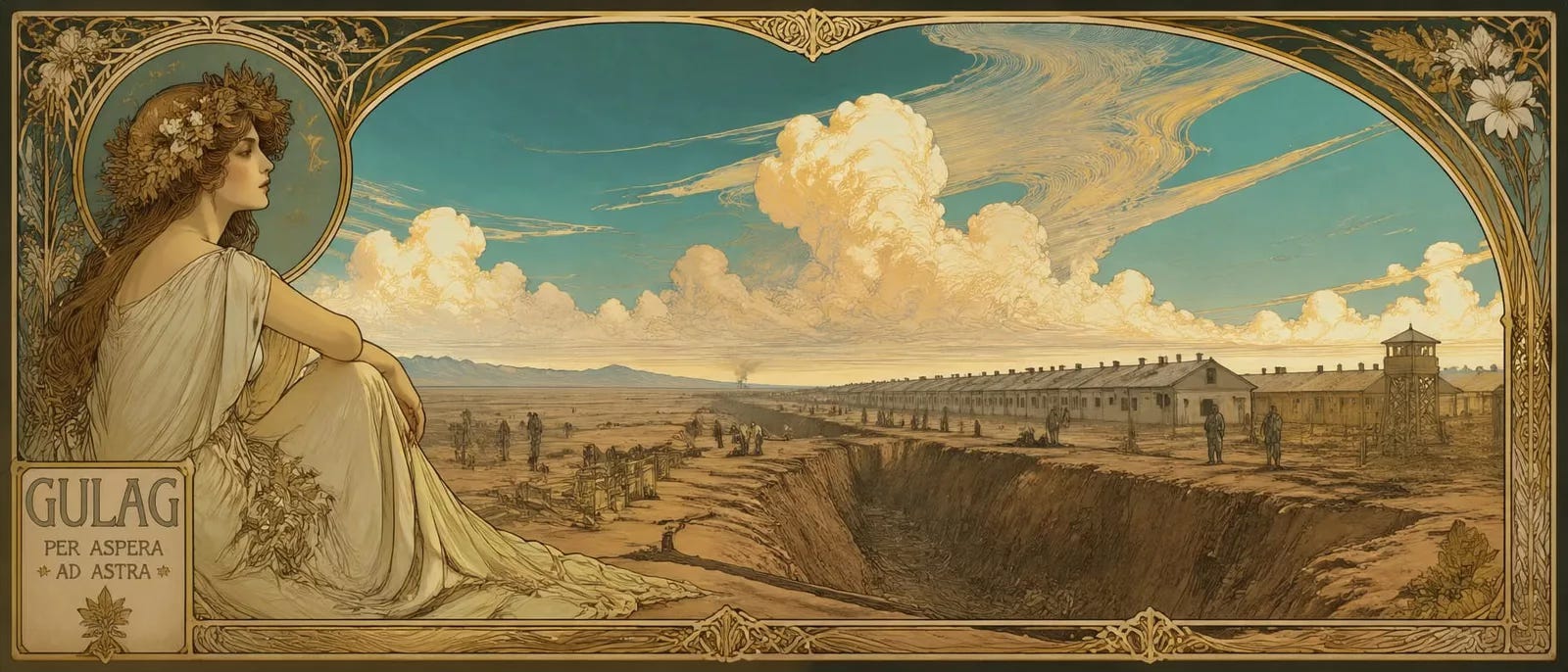
Collective Shooting Range 9 occupied forty-five hectares, some twenty-five kilometers beyond the Kosmohaveno. It had no fences, no barriers: just watch-towers, four of them. The unterraformed desert was a barrier enough. There was no collective, exactly. Administratively, it was in Aulis Polis, or, rather, Aulis Nome, or perhaps Polis again. One must be careful with one’s words.
And shooting range—well, it had been built by the People’s Army for sharpshooting and combat training. Now the PoKPO ran it. So it was said.
There were four deep ditches, and four rows of board-and-paper huts, and the PoKPO, before dawn, rousted out the inmates of Hut C-7, and marched them to Trench C. They were gray-faced, as thin as crow-scares, and looked dully at the armed men. There seemed little behind their sunken eyes. They were, or had been, men, and now the dirt crumbled under their bare feet as the cold wind whipped out of the west in the gray-green dawn. They coughed lightly: the…recent troubles had caused work on the soils of the flatlands towards the Silver Coast to cease, and alkalis were in the air again. Outside, the PoKPO men wore battered old respirators. The dead-eyed men had nothing.
The cornet in charge of the squad looked at the twenty men, looked at his tablet, then he jerked his thumb. His unit punched and kicked and hit with carbine-butts, and the prisoners slid down the slope, flopping and tumbling through dirt and regolith. The safeties banged off.
In his house, the full-captain in charge of CSR-9 arranged his egg and his toast and snapped his fingers at his gray-faced server, who hurried forward and poured more coffee. The tablet by the plate had a list of thirty-two names. Full-Captain looked at them, frustrated. The huts, built for a crowded ten, held twenty at a pinch. “You tell them and tell them,” he said. Thirty-two was straight out. He ticked down the list with his finger, striking off the first twelve. His orderly stood to the side, and Full-Captain flicked the amended list to the junior officer’s tablet.
“Liquidate the first dozen at once.’
“Yes, sir.”
“And who’s this? Do I recognize that name?”
The order leaned forward. “Yes, he was the author of Against the Trekkers.”
“We have a notable among us.” The name was the thirteenth on this list. Of such random things, he thought, life was built. “I’ll see him when he comes.”
They listened to the shooting. There was hardly any noise from the prisoners, except one who wailed a few times, before a last pistol-crack silenced him. The full captain ate his toast, then went to his door, floor creaking and popping under his boot heels, and watched the residents in Hut C-6 and C-8 emerge and pick up spades waiting along the ditches. The shuff-shuff, suff-shuff, suff, of the dirt and the clack of stones made Full-Captain’s face tense in the imitation of a smile. Across the desert, a puff of dust approached down the miserable road to Aulis.
The creaking army-lorry disgorged thirty-two human forms, the new residents of C-7. One, number nine on the list, was dead, and it was by the cornet’s hesitation over the conflicting order (Kill twelve? Preserve Leiko?) that one of the provisional government’s…former socio-political theorists was preserved from prompt liquidation. The nineteen survivors of the trip and culling were introduced to their hut and the rules, abused, and then Leiko, with bloody nose, was taken to the Collective Shooting Range 9’s commander.
The full-captain looked him over, tapping a stylus on his desk. “So you’re Leiko.”
The man was shabby, unshaven, with sores on his face, hair butchered by some prison barber. He wore gray clothing, shapeless, and shoeless. His arms hung stiffly and he heard the officer but did not look at him. He looked a hundred years old. “Yes, sir.” The full-captain wondered what lightless hole he’d been kept in, and for how long.
“Quite the signal honor,” Full-Captain said. “I saw you speaking at the Great Council twenty years back. I was still in school. You inspired in me,” he went on, “quite the hatred of the propertarians.”
“Yes, sir.”
“You’re a clone, aren’t you?”
“Yes, sir. The people fight—”
“To free the clones, yes, yes. I always thought it interesting that you were able to pursue such an academic career, coming from such a background.”
Leiko shook his head slightly, as if to say, how does one summarize a meaningless life?
“Wasn’t there talk of you being premier, someday?”
“It didn’t matter what I did. I was doing the people’s work,” Leiko said.
“You’ll do the people’s work here, too—for a while. Now! You’ll go back out and help finish the burial detail, then I think you’ll find the People’s Officer’s Latrines need scrubbing.”
Leiko lifted his head and looked at the open door. The dozen fresh-shot and the man who expired on the lorry were sprawled in the ditch, almost out of sight. An arm stuck up. Full-Captain did not know it, but it was the arm of Leiko’s son-in-law. “Yes, sir.”
“Then it would be a pleasure to hear you read,” the officer opened a squeaking drawer and tossed out a thick book, “from your collected essays.” He made the thing like a smile again. “But the latrines first. I don’t want to smell anything when I shit in it, or I’ll put you down it.”
“Yes, sir.”
“Careful of the chemical you use,” the full-captain said, standing. “If it splashes you, it’s a terrible burn. Cornet—put him to work.”
“Yes, sir,” the cornet said, and he led the political theorist away.
This week’s prompt challenge was from Fiona Grey: “Beware toilet cleaner splashes!” It probably went darker than she intended. My prompt went right back to Fiona Gray. See all the challenges and responses over at More Odds Than Ends!

The Pearl Crucible: A Dardana Fenek Mystery (Incidents on Iphigenia Book 4)(Amazon link)
Sci-fi Romance and How I Learned to Love Reading Again, by T. A. Leederman (review)
And more—now out!